

Structural Intelligence for Income Investors.
Canonical, Financial Literacy Intelligence
Insight Beyond Income
Structural intelligence for preferreds and income instruments


Grounded in capital hierarchy, liquidity behavior, and recoverability under stress
Explains why income strategies fail quietly, before price makes it obvious
What PARGamma Does
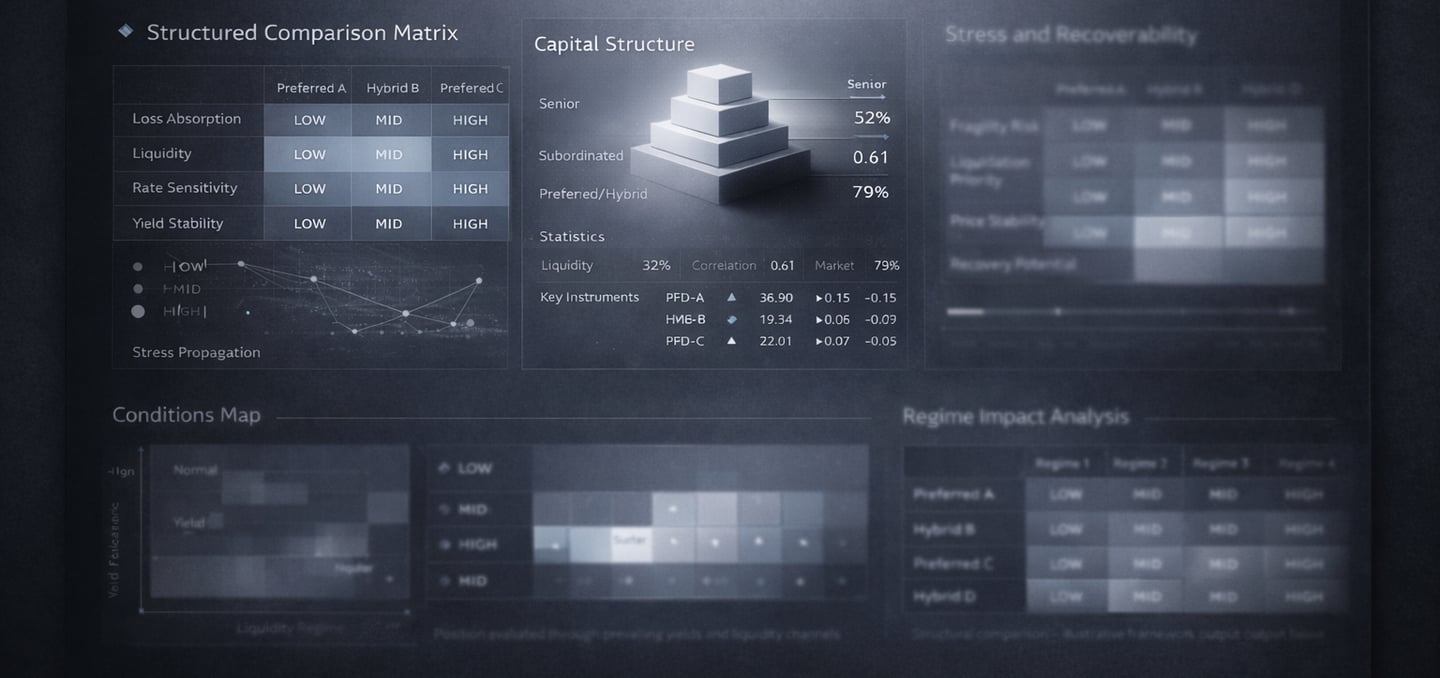

PARGamma analyzes preferred and hybrid income instruments through structural comparison rather than recommendation.
• Where instruments sit within the capital structure
• When price stability is conditional rather than durable
• Revealing how stress and liquidity propagate across regimes
• Rationalizing how similar yields can produce very different outcomes
Gamma Applied Structural Analysis
This panel represents applied framework output. Delivery begins through structured analysis and extends into systemized intelligence over time.
Sample Intelligence Brief Framing - January 2026
Frame 2:
Frame 4:
Structural Observation — Liquidity Behavior
What This Invalidates
Frame 1:
Frame 3:
Applied Structural Comparisons
Structural Context
Sample excerpt
"In a binding regime, surface similarity obscures material structural differences. Instruments that appear comparable by issuer quality or coupon continuity diverge meaningfully once hierarchy and liquidity conditionality govern outcomes."
Sample excerpt
"By late-2025, liquidity became conditional. Access increasingly depended on reversibility, capital treatment, and balance-sheet efficiency rather than on sentiment or yield demand."
Sample excerpt
"Coupon payments and dividend continuity no longer serve as reliable indicators of structural resilience. Repricing can occur without interruption and without signaling issuer distress."
Sample excerpt
"Because these resolutions occurred sequentially and without crisis markers, they did not register as destabilizing events. Structures that relied on balance-sheet elasticity, discretionary sponsorship, or steady secondary-market depth continued to function."
What this section does
Explains non-event-driven repricing. This section shows how liquidity becomes conditional rather than disappearing, and why price moves can occur without volume or catalysts.
Explicitly retires obsolete assumptions. This prevents legacy frameworks from being misapplied to a new regime.
Explains why conditions can feel stable even as tolerance has narrowed. This section reduces confusion and prevents readers from mistaking the absence of stress for structural safety.
Destroys false equivalence. Using tables and structure-level comparisons, this section allows practitioners to discuss risk without naming securities or revealing positions.
What this section does

Why Structure Matters
Income instruments are rarely judged by markets solely on whether they pay. They are judged on how they behave when pressure moves through the system.
Liquidity shifts, rate regimes, and changes in risk tolerance often reprice income instruments long before dividends change.
Income outcomes are structural long before they are visible.
PARGamma exists to make that structure legible.
How Income Investors Use Our Work
Practitioners use PARGamma to:
• evaluate tradeoffs between income structures
• identify hidden fragility before it appears in price
• distinguish volatility from permanent repricing
• avoid instruments with poor recoverability profiles
• improve decision consistency across market regimes
Decision quality always trumps activity.


Access
Public Research
Subscriber-only structural comparisons, regime analysis, and ongoing refinement of classification logic.
Institutional access and research licensing available upon inquiry.
Income outcomes are structural long before they are visible.
Proprietary Research
Framework essays and structural analysis designed to establish orientation and shared language.
PARGamma exists to make that structure legible.
Structural intelligence for preferreds and income instruments.
engage@pargamma.com
© 2026. All rights reserved.
PARGamma Research Group
About
PARGamma is an applied research platform focused on how income instruments behave under changing market regimes.
The work emphasizes capital hierarchy, liquidity behavior, and recoverability under stress to explain outcomes that are often misunderstood or recognized only in hindsight.
research access
ownership & Affiliation
PARGamma is a wholly owned applied intelligence division operating within a broader research and inference architecture.
The platform functions independently while sharing foundational analytical principles with affiliated research initiatives. Institutional research licensing and internal-use access are available upon inquiry.
Institutional & Research Inquiries
Unauthorized reproduction, redistribution, or commercial use of applied materials is prohibited.
legal & disclosure
PARGamma provides structural analysis and educational research for informational purposes only.
Nothing on this site constitutes investment advice, a recommendation, or a solicitation to buy or sell any security.
Analysis may reference specific instruments to illustrate structural characteristics, but does not provide trade directives or personalized guidance. Readers are responsible for their own investment decisions and should consult qualified professionals as appropriate.
Contact
institutional@pargamma.com